BMS development that stays accurate in every condition
How accurate is your BMS when the cell is full or empty, warm or cold, new or aged?
BMS development means estimators for state of charge, state of health and state of power that hold in every condition, and a system that stays safe. They are developed against a plant model. With a physics-based Batemo Cell Model as plant model, model errors do not become estimation errors, and every code change is tested against the physics.
Talk to a battery engineer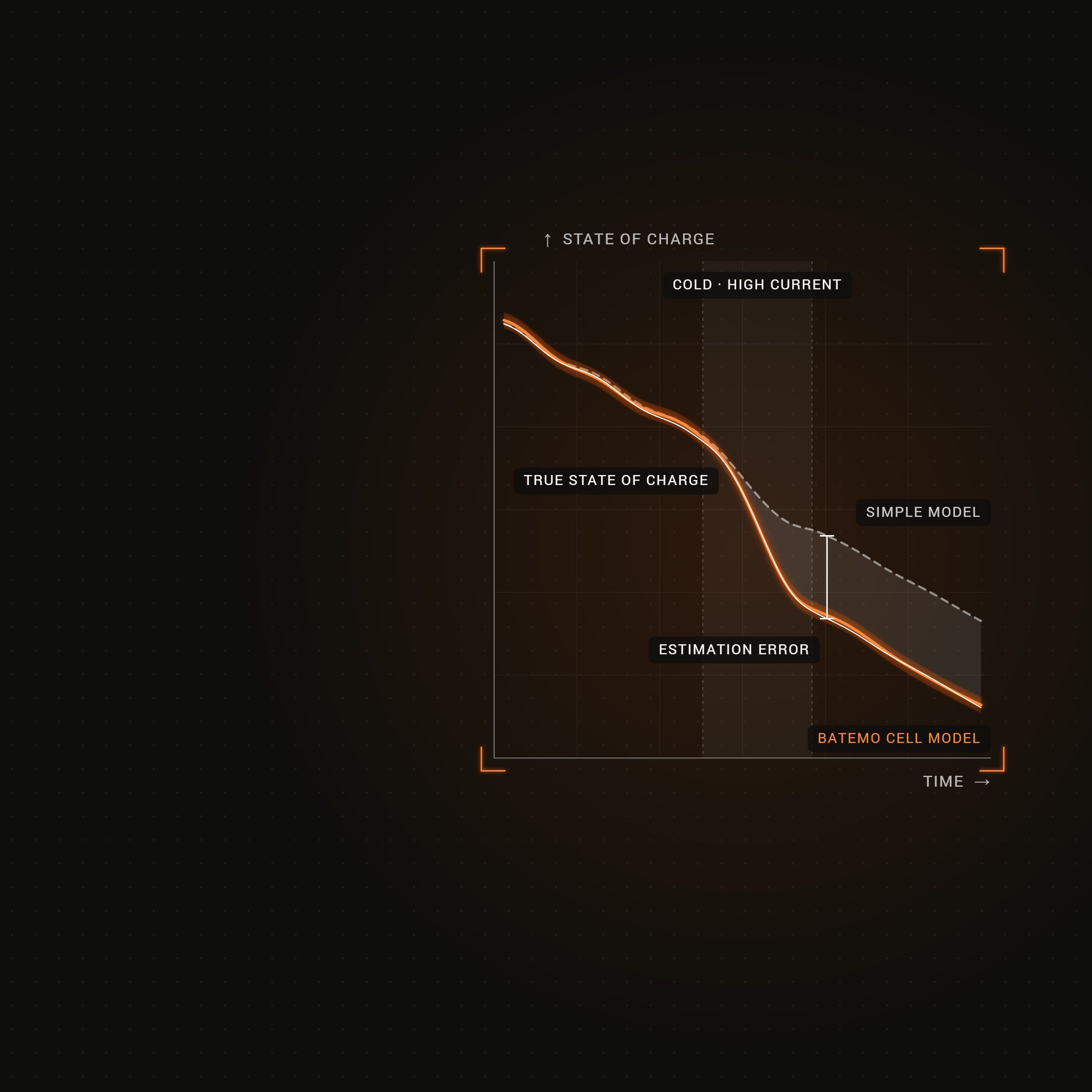
BMS development: today and with a Batemo Cell Model
Today, BMS algorithms are tuned against a simple Equivalent Circuit (RC) model and corrected on the bench and in hardware-in-the-loop tests. With a Batemo Cell Model in the loop they are developed and tested against the physics, from the first parameter set to the code on the microcontroller.
Measured vs. Batemo Cell Model
voltage / V
capacity / Ah
- 0.45 A
- 4.45 A
- 17.81 A
- 35.62 A
- 49.42 A
0.7%
voltage deviation of the model, RMS over all validation tests
Today
Test to parameterize the estimator.
The estimator needs its own cell model, and parameterizing it takes typically 30 days of tests on the bench.
With a Batemo Cell Model
Parameterize it virtually.
The Batemo Cell Model replaces the parameterization tests with virtual ones: far more tests than a bench can run, densely sampled, within one day.
You gain: 30 to 1days to parameterize your estimator model
Today
Use a simple RC model.
Software-in-the-loop runs against a lookup table or an equivalent circuit from a handful of bench measurements. Its errors become errors of your estimator.
With a Batemo Cell Model
Develop against reality.
The Batemo Cell Model is your plant model and matches the real cell, so plant-model errors do not turn into estimation errors. Want to check it yourself? Batemo Cell Data gives you the measurements behind the model, ready for your own validation without testing a single cell.
You gain: Realityas your plant model, so model errors do not become estimation errors
Today
Test a handful of scenarios.
A bench runs a few cold starts, pulses and aged cells. The corner cases that hurt are the ones nobody ran.
With a Batemo Cell Model
Test every code change.
Automated routines run thousands of scenarios a day and check every code change against the real physics, across the full operating range.
You gain: ÷ 10residual error probability in your BMS software
Today
Validate on new cells only.
An aged cell first has to be produced on the bench, so most estimators are checked on fresh cells and drift as the cell ages.
With a Batemo Cell Model
Build a robust BMS.
The physical model ages cells virtually, on physical grounds, long before real aging tests are done. Your BMS stays accurate whatever aging actually occurs.
You gain: Robustaccuracy over the whole life of the cell
Today
Find the problems in HIL.
Code is generated for the microcontroller, and hardware-in-the-loop tests bring up what the RC model missed. Each finding means another redesign loop.
With a Batemo Cell Model
Implement it straight away.
Because the Batemo Cell Model matches reality, little new turns up in HIL or PHIL tests. Your software is tested virtually and goes onto the microcontroller without surprises.
You gain: Fewer loopsa straightforward implementation, fewer redesigns
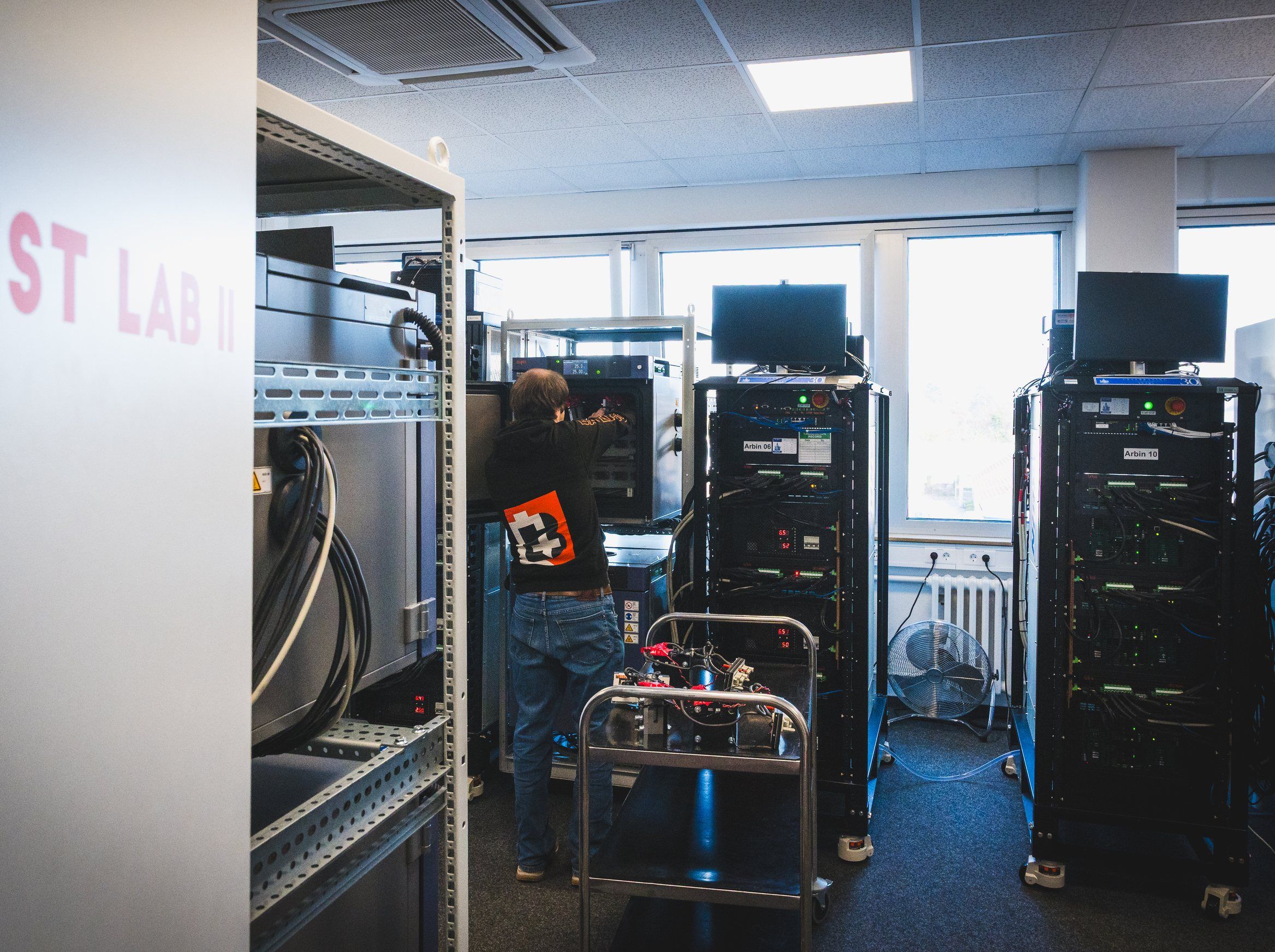
Fewer surprises on the HIL bench
When the plant model matches reality, the hardware-in-the-loop test confirms your software instead of finding its errors. Each loop you save is weeks of testing.
Accurate across the operating window
A BMS has to estimate state of charge, health and power wherever the cell operates: full or empty, warm or cold, at low and at high current. The plot shows the measured operating window of one cell: the usable energy it delivers at each discharge power. A Batemo Cell Model is validated against measurements like these.
Measured operating points
usable energy / Wh
discharge power / W

Questions about BMS development
Why can't a BMS measure state of charge directly?
State of charge is not a measurable quantity. A sensor reads voltage, current and temperature. The BMS infers charge from these readings and from a model of the cell. Because voltage also depends on load, temperature and age, the inference drifts. Every percent of error costs usable range at the bottom and safety margin at the top. That is why physics-based simulation matters: with it, you improve your BMS algorithms and use more of the cell.
What limits SOC estimation accuracy?
Four things: the quality of the cell model behind the estimator, sensor error, the shape of the open-circuit voltage curve and the aging of the cell. A flat voltage curve turns small sensor errors into large state-of-charge errors. Cold temperature and high current move the operating point away from the calibration. There is a solution for each of these problems, and it is developed with physics-based simulation.
How do I test a BMS without hardware?
Use software-in-the-loop. The BMS code runs against a plant model of the cell, and automated routines replay scenarios: cold starts, high-current pulses, aged cells. Because Batemo Cell Models run within seconds, you can run thousands of scenarios a day. Hardware-in-the-loop and bench tests then confirm a design that has already been stress-tested.
Why does a physics-based plant model reduce BMS errors?
A plant model with the wrong structure turns its own errors into errors of the BMS. A physics-based model describes the electrical, thermal and physical processes inside the cell. It stays valid under cold, high-current and aged conditions, where a lookup table or a fitted circuit drifts. The estimator is tested against the physics, not against its own training data.
Can I validate my BMS against measured data without running my own tests?
Yes. Batemo Cell Data holds the measurements behind each Batemo Cell Model: constant currents, pulses and power profiles across the operating range. You can run your estimator against model and measurement side by side without testing a cell yourself. For most development work, the validated model alone is enough. The Batemo Cell Model can also run the parameterization tests of a BMS model virtually, so you get to a higher-quality BMS model faster.
How accurate are Batemo Cell Models?
Across 198 validated cells the median model deviation is 0.8 %, measured against validation experiments. This is the accuracy of the reference your estimator is tested against, not of the estimator itself. Batemo backs its models with a guarantee: if you can show us another battery cell model that is more accurate, we will refund your money. We publish the accuracy of every model on its own cell page on this website, and for every model we provide Excel reports that show its accuracy under the validation conditions in detail.
Two ways to start your BMS development
If you need the decision
Bring us the estimator you are developing.
An engineer who has measured these cells reads your message — not a mailbox, and not a sales desk that forwards it.
If you need the data
Validate against measured data.
Batemo Cell Data gives you the measurements behind the model: constant currents, pulses and power profiles across the operating range, ready for your own validation without testing a single cell.
Or start with the measurements — explore the public Batemo Cell Explorer →