Battery cell design without waiting for the next prototype
See the consequence of a design change before anyone builds it.
Battery cell design means setting electrode thickness, loadings, particle sizes and geometry to reach targets for energy, power, charging time and lifetime. The Batemo Cell Designer starts from a validated model of your latest cell and computes thousands of variants, so only the best design goes to prototype. In one real study, power density rose by about 30 %.
Talk to a battery engineer
Battery cell design: today and with the Batemo Cell Designer
Today, every design idea is a prototype, and a prototype takes months. With the Batemo Cell Designer the design study comes first, and only the designs that already reach the targets go to prototype.
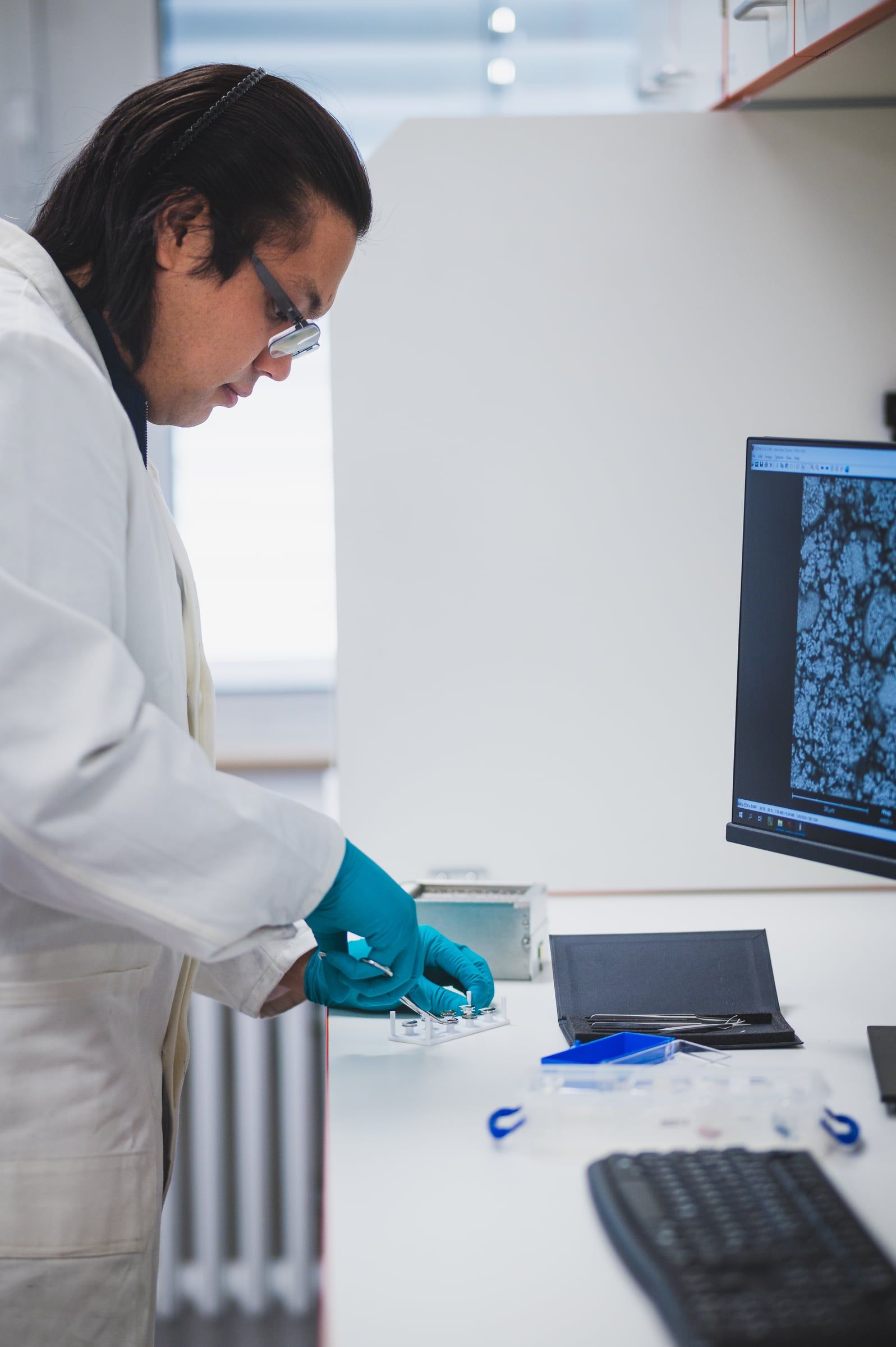
Today
Start each idea with a prototype.
Electrodes are coated, the cell is assembled and formed, and only then do you see what the change did.
With the Batemo Cell Designer
Start from reality.
Batemo builds a physical model of your latest cell, electrode or material and clarifies the processes inside it. On this validated starting point you swap electrodes, change the electrolyte or vary any design parameter.
You gain: Realityas the starting point, so the predictions hold
Today
Try a few variants a year.
The number of ideas you can test is set by how many prototypes fit into a year. Most of the design space stays unseen.
With the Batemo Cell Designer
Explore the whole design space.
Every cell maker has its own strengths in materials and process. The Batemo Cell Designer computes thousands of variants of your technology, each within seconds, so you see where its limits really are.
You gain: The whole spaceof your technology explored, not sampled
Today
Find the trade-off late.
A thicker electrode gives more energy and worse behavior at high current. The power target fails one prototype later.
With the Batemo Cell Designer
Balance every target.
Energy, power, charging time, lifetime, cost and safety are computed together for each design, so the Batemo Cell Designer finds the best balance between them. In one real study, power density rose by about 30 % at about the same energy density.
You gain: Optimalbalance of all targets, e.g. +30 % power density at the same energy density
Today
Wait for the target format.
Early prototypes are coin cells or single-layer pouches. How the design behaves in the final cylindrical or pouch cell shows only once that format is built.
With the Batemo Cell Designer
Predict the target format early.
From early single-layer or coin-cell prototypes, the Batemo Cell Designer predicts how the design performs in the target format, so you know early which direction to take.
You gain: Earlytarget-format behavior from the first prototypes
Today
Answer a customer request with a build.
A customer names the targets, and finding the right cell means more prototypes and more months.
With the Batemo Cell Designer
Translate requirements into a cell design.
Enter the customer's targets and the Batemo Cell Designer finds the design that meets them best within your technology.
You gain: Weeksfrom customer requirement to cell design, not months
Today
Judge a material in isolation.
A new material is tested in a half cell. What it changes in the finished cell, or in the end user’s system, shows much later.
With the Batemo Cell Designer
Develop for the end user.
Model next-generation materials very early and see what they bring in the finished cell and even in the finished system. Batemo covers the whole chain from material to system.
You gain: What mattersto the end user, from material to system

Every parameter moves every target
Thickness, porosity, silicon content: each design parameter shifts energy, power, charging time and lifetime at once. The Batemo Cell Designer computes the trade-offs before the first prototype.
How long is your own design loop?
The three numbers up front describe your program, and they are yours to change. Under “How this is calculated” you find the four we assume about our side of the work, each with its source.
- Starting cell255 Wh/kg · 1,945 W/kg
- Design variants
- Design target
- 342 more sample cells
At 0 % you start now, with the full saving ahead.
How this is calculated4 fixed assumptions
Without a model, the time to design freeze is simply the iterations you have left times the weeks one of them takes. With a model, the iterations happen as calculations: one-off model development, then design work per iteration, plus validation on the share you still build. If that came out longer than building everything, the calculator keeps the shorter of the two — a model you would not start is not an advantage.
- Model development at Batemo, once
- 8 weeks
- Working figure from Batemo's battery engineers.
- Digital design work per iteration
- 1 week
- Working figure from Batemo's battery engineers.
- Validation per iteration
- 4 weeks
- Working figure from Batemo's battery engineers.
- Iterations still validated physicallyShare of iterations that still get a real build and a real test, even with simulation in the loop.
- 40 %
- Working figure from Batemo's battery engineers.
Questions about battery cell design
What is battery cell design?
Battery cell design is the process of choosing the parameters that make up a cell, for example dimensions and geometry, electrode thickness and loading, porosity, particle size, electrolyte, layer structure and tab layout. The aim is to reach targets such as energy, power, charging time, lifetime and cost at the same time. Each choice affects the others, which is why the work is often called an art.
How does electrode thickness affect energy and power?
A thicker electrode holds more capacity per area, so a cell stores more energy. The trade-off is behavior at high current: ions travel further and the cell loses more capacity under load. Areal capacity is therefore the number a cell designer sets first, and almost every trade-off runs through it.
Can simulation replace prototyping in cell design?
It replaces most of the trial builds, not the last one. You run a simulation study on meaningful parameter variations, build the next prototype, validate it and repeat. Only designs that already look right go to a prototype. The final design is always validated on a real cell.
Why not use microstructural finite-element models for cell design?
They can answer the question in principle. In practice, parameterization takes months and a single simulation run takes hours. You also have to make sure yourself that the model is valid. Trust us, that is a hard job. And you want to design cells, not validate models, right? So the overall process is too slow and error-prone for a design loop with thousands of variations. A physics-based Batemo Cell Model with the Batemo Cell Designer runs in seconds and solves these issues.
How accurate is the Batemo Cell Designer?
The Batemo Cell Designer builds on the Batemo Cell Model. Across 198 validated cells the median deviation of the Batemo Cell Model is 0.8 %, measured against validation experiments. The Batemo Cell Designer inherits this accuracy, but it becomes less accurate the further your design moves away from the validated starting point. This is no problem: whenever predictions tend to become inaccurate, you build the next prototype, validate it and repeat.
Two ways to start your next cell design
If you need the decision
Bring us your latest cell and your targets.
An engineer who has measured these cells reads your message — not a mailbox, and not a sales desk that forwards it.
If you need the data
See the measured cells your design competes with.
Batemo Insights holds the measured behavior behind every cell in the Batemo Cell Explorer — including what the public Explorer deliberately does not show.
Or start with the measurements — explore the public Batemo Cell Explorer →