How to master battery aging
How fast a cell ages depends on how it is used and stored, and on the cell itself. Every cell is different.
Battery aging decides warranty, range and when your system can be signed off. How fast a cell ages depends on temperature, state of charge, current and time, and on the cell itself. Mastering it in series development takes tests, simulation and the right cell and system design working together, from the first day of the project.
Talk to a battery engineer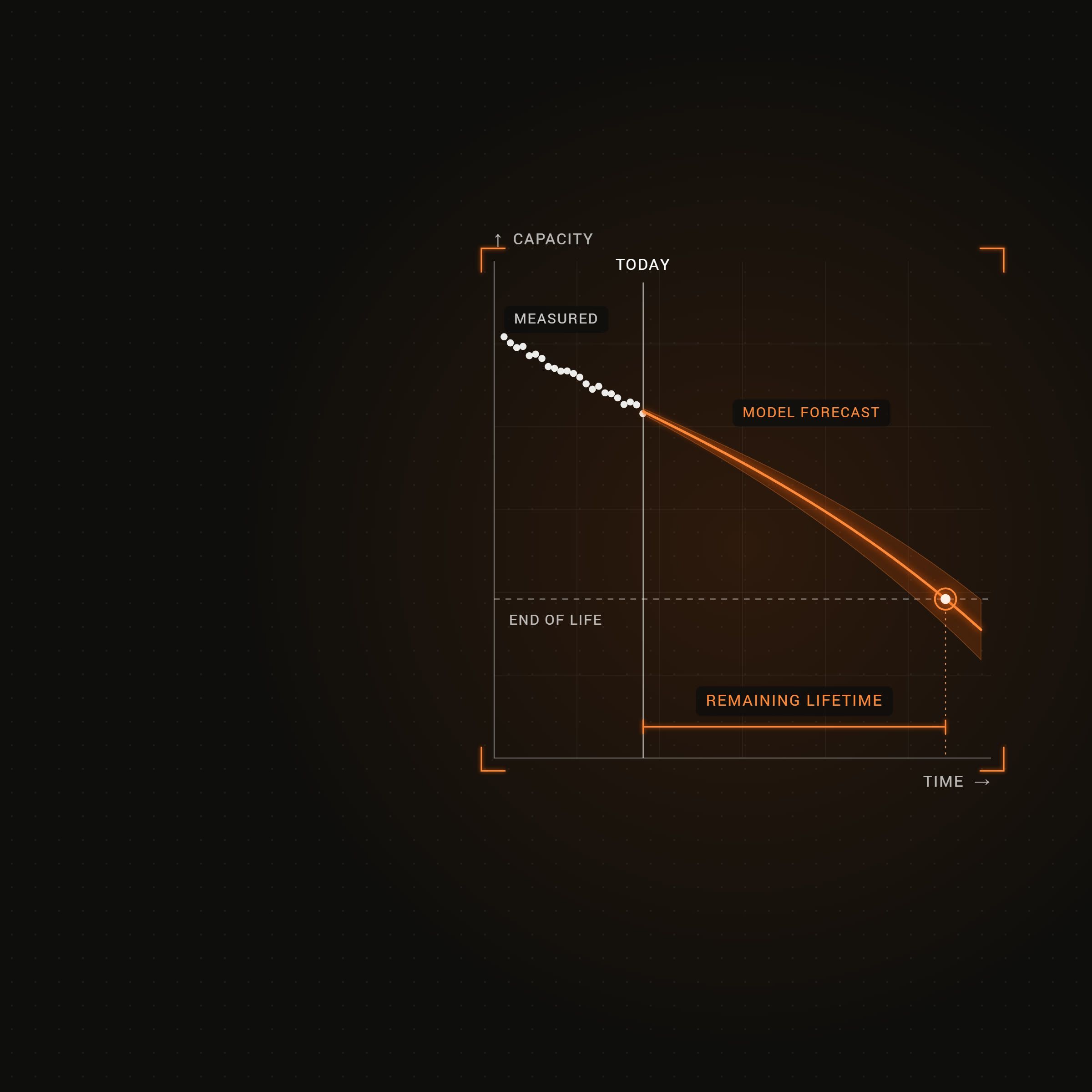
Mastering battery aging: today and with Batemo
Today, aging is predicted by fitting a curve to months of cycle and calendar tests. With Batemo you consider aging from day one, understand what drives it and secure your lifetime claims on physical grounds.
Today
Wait for the tests.
Aging tests take months if not years. Until they end, typically six months into a project, the system is designed without an aging estimate.
With a Batemo Cell Model
Consider aging now.
Batemo's aging database covers the cells of the Batemo Cell Model Library. By transferring what was measured on the same chemistry, physically, Batemo makes aging statements for every modelled cell right away.
You gain: Nownot in six months, when the aging tests end
Today
See the decline, not the cause.
A capacity curve fitted to throughput and time does not show what happens inside the cell. Decisions are made blind.
With a Batemo Cell Model
Understand what happens.
Batemo identifies the aging mechanisms and builds them into the Batemo Cell Model. You see what really ages the cell, and simulate how it plays out in your system: in the BMS, in the cooling, under any condition.
You gain: Understoodaging mechanisms, and their effect in your system
Today
Extrapolate and hope.
The range you need is usually beyond the tested conditions, exactly where a fitted curve is least reliable.
With a Batemo Cell Model
Go beyond the tests.
Because the model rests on the physics of aging, not on a generic fit, statements beyond the tested conditions are more reliable.
You gain: Beyondthe tested conditions, with more reliable lifetime claims
Today
Sign off late.
System sign-off waits for the lifetime evidence, and the evidence waits for the aging tests.
With a Batemo Cell Model
Reach sign-off sooner.
With aging modeled from the start, the lifetime evidence is ready earlier. In projects, three to four months can be gained on the way to sign-off.
You gain: Soonersign-off, three to four months earlier in projects
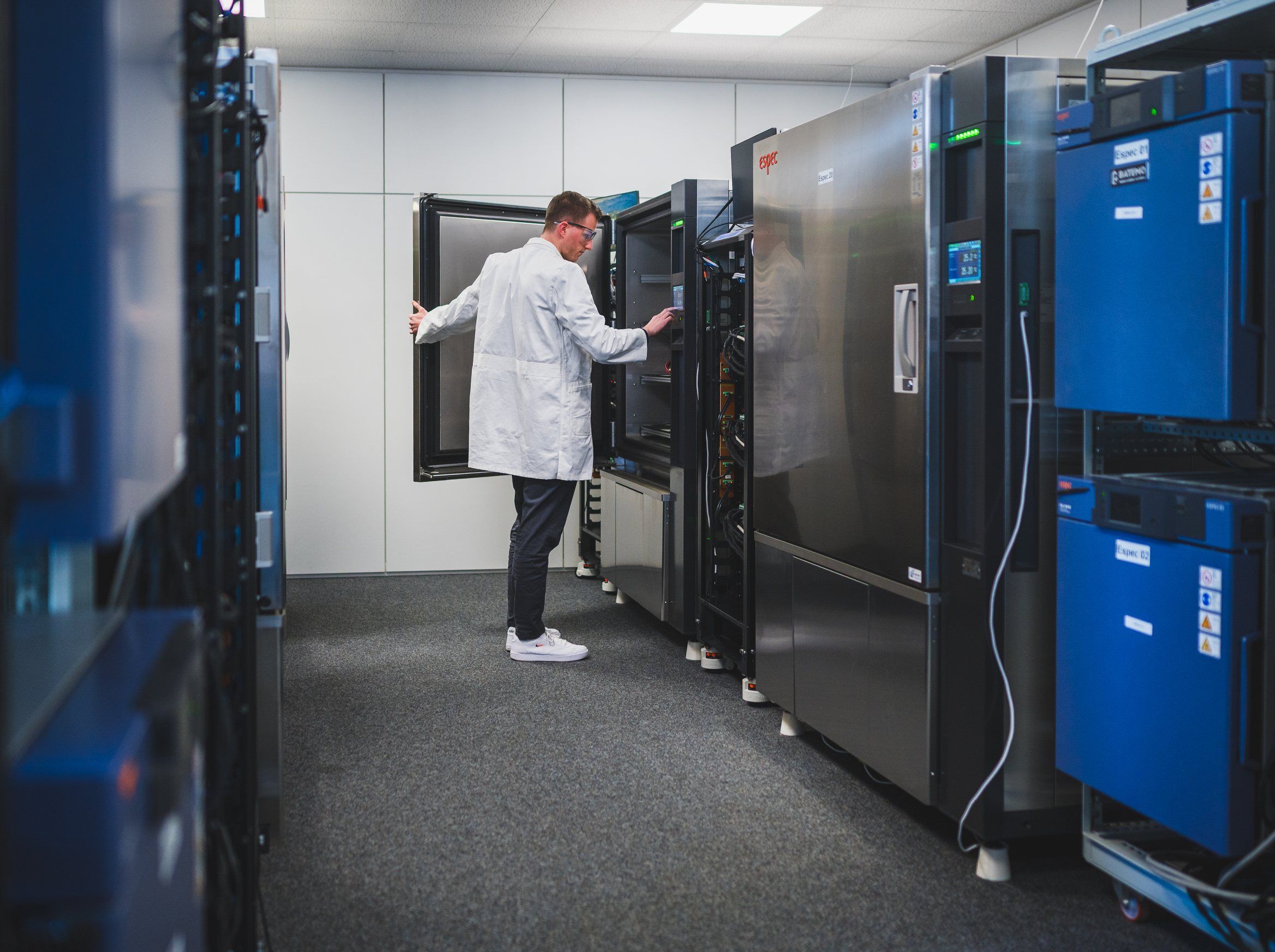
Months in the chamber
Aging tests run for months in temperature chambers. Until they end, the system is designed without an answer.
What is actually aging your cell?
Age alone is not the driver. Temperature, the state of charge you sit at, how hard you charge and how often decide how fast a cell ages. Set your own operating strategy and see which of them dominates.
Measured batch variation
CapacityAh
Internal resistancemΩ
- ± 0.12 %spread in capacity, 4 cells, mean 2.0749 Ah
- ± 2.22 %spread in internal resistance, 4 cells, mean 18.44 mΩ
1 C fills the cell in one hour, 2 C in half an hour.
How this is calculated2 more inputs
Six drivers are rated separately — the temperature range, how long you sit at a high state of charge, the depth of discharge, the charge rate, the discharge rate and how often you cycle. Each one saturates: beyond a certain level, more of it stops making things much worse. The chemistry you picked then scales each driver up or down, and a driver that is already high is weighted harder, because a single dominant driver decides a cell life on its own. Fast charging also sets a floor that depends on the coldest temperature: from 25 °C, 3 C means at least high risk and 4 C very high; at 0 °C and below, 1 C is already high and 2 C very high. An LTO anode tolerates far higher charge rates and only reaches medium from 5 C. The result is one of five levels, from very low to very high. It is a screening, not a lifetime prediction: it tells you which mechanism to look at first, not how many cycles you will get.
More about how you use it
2 C empties the cell in half an hour.
Starting points: Passenger EV, City bus, Drone, Grid storage. Typical duty profile, a working figure from Batemo's battery engineers.
Questions about battery aging
What is a battery aging model?
A battery aging model predicts how a cell loses capacity and power over time and use. Correlative models fit measured data and work where data exists. A physics-based aging model identifies the mechanisms behind the decline, so it can simulate aged cells under conditions you never tested. However, the goal is not simply to model aging. The goal is to release the finished battery system for series production as soon as possible, without any aging issue. That only works with a combination of tests and models, because you cannot test for as long as your statements have to hold. That is why Batemo's approach combines testing and modeling.
What is the difference between calendar aging and cycle aging?
Cycle aging comes from charging and discharging. Calendar aging happens while the cell sits, and depends on temperature, state of charge and time. In a product that stands still most of the day, calendar aging can dominate. A test plan has to cover both, because the operating strategy that helps one does not always help the other.
How long does a battery aging test take?
Aging tests take months, often years, because the cell has to live through the wear you want to predict. Accelerated tests shorten this but change the conditions. Typical test matrices try to finish the tests within six months, which brings its own problems. To speed things up, a first estimate from Batemo's aging database is available right away, and Batemo can put your results in context. On that basis, we propose tests and build the best connection between test and model, so you reach series release earlier.
Can I extrapolate aging test data?
Only with care. Methods based on correlation are accurate where data was fitted. The range you need is usually the one beyond the data. A model built on the physical processes stays meaningful outside the tested points. Key scenarios must be checked by a test, because anything else is unreliable.
Which operating conditions age a cell fastest?
Six drivers matter: the temperature range, time at a high state of charge, depth of discharge, charge rate, discharge rate and cycle count. The calculator on this page rates them as an aging risk from very low to very high for your operating strategy. It is a screening, not a lifetime prediction: it tells you which driver to look at first.
How accurate are Batemo Cell Models?
Across 198 validated cells the median model deviation is 0.8 %, measured against validation experiments. Batemo backs its models with a guarantee: if you can show us another battery cell model that is more accurate, we will refund your money. We publish the accuracy of every model on its own cell page on this website, and for every model we provide Excel reports that show its accuracy under the validation conditions in detail.
Two ways to master battery aging
If you need the decision
Bring us the lifetime requirement you have to meet.
An engineer who has measured these cells reads your message — not a mailbox, and not a sales desk that forwards it.
If you need the data
See the measured aging data of the cells you consider.
Batemo Insights holds the measured behavior behind every cell in the Batemo Cell Explorer — including what the public Explorer deliberately does not show.
Or start with the measurements — explore the public Batemo Cell Explorer →